
Prompt engineering vs context engineering. These topics emerges and become quite popular in designing a good and working LLM, especially in Agentic AI world. These 2 topics are actually disciplines to be followed in crafting while working with LLMs. Both sounds similar between each other, but it is not.
Imagine walking into a coffee shop and ordering coffee. The barista keeps looking at you, waiting patiently. You realize that you need to be quick and specific in ordering. “An ice latte, with two pumps of hazelnut, medium cup”. That is a specific request, providing those details ensure the barista understands your orders.
But here’s the thing, that request only works because you’re standing in a shop that has the beans, the milk, the espresso machine, and your past loyalty rewards that is already recorded on file. Without that entire behind-the-scenes setup, you’re just a person shouting specific instructions at an empty kitchen.
In the world of AI, we spent years perfecting the 'order' (Prompt Engineering), but we are now realizing that the real magic lies in building the 'coffee shop'(Context Engineering) infrastructure itself."

Prompt Engineering
Prompt engineering is basically a practice of designing, structuring, and optimizing inputs to an LLMs so that it is reliably produces the desired behavior or output. It is a discipline to help humans communicate effectively with LLMs.
According to Intuition Labs, Prompt Engineering emerges around 2020-2021 when the release of GPT-3 by OpenAI. Before ChatGPT, researchers and “early adopters” discovered that the GPT-3 outputs changed drastically based on how the prompt is being designed. Hence, the era of Prompt Engineering started and this also led to the discovery of Few-Shot Prompting(providing examples to the LLM) and Chain-of-Thought(working something step-by-step).
Article by Intuition Labs: https://intuitionlabs.ai/articles/what-is-context-engineering on Emergence of Prompt vs Context Engineering
On late 2022, when ChatGPT launched, prompt engineering has moved from a niche research interest to a mainstream job and skill set. People are quickly adopting and selling prompt libraries and creating frameworks to utilize the prompts in LLM.
Back to the topic, prompt engineering is basically how we structured and engineered the prompt in order for LLM to process and provide output accordingly. This includes:
- Role assignment to the LLM
- Persona or identity
- Few example for the LLM to works with
- Constraint setting
- Tone definition setting
Context Engineering
If prompt engineering focused on the prompt that being passed to LLM, to ensure prompt are easily understood, the assignment are fully specified, and the LLM are guarded with constraint, context engineering on the other hands covers the bigger scale in designing a full-functioning LLM, in most cases AI Agents.
Context engineering is the practice of selecting, structuring, and injecting the right information and tools in LLM’s context window, so that the model able to produce accurate, grounded, and precise actions or outputs.
Context engineering emerges a bit late, around 2024-2025. It is a more recent and technical evolutions. It gained tractions in late 2024 become more dominant in 2025.
Intuition Labs mentions that:
By 2024, industry leaders began emphasizing the need to shift focus from just prompts to the broader context provided to models. Influencers like Andrej Karpathy and organizations like Gartner declared that “prompt engineering is out” and “context engineering is in” ([1]) ([20]). The term “context engineering” itself began to circulate in 2024–2025, often credited to Karpathy’s talks (e.g. “Software is Changing (Again)” talk at YC’s AI School). It reflects a fundamental shift: instead of only improving the wording of prompts, developers are now building entire pipelines and environments around the AI. As one data scientist put it, context engineering is like “stocking the pantry, prepping the ingredients” for the AI chef ([21]).
Article from Intuition Labs: https://intuitionlabs.ai/articles/what-is-context-engineering
Context engineering covers:
- LLM memory managements, whether it is short term memory or long term memory.
- State managements in the graph.
- RAG in order to provide grounded answers, instead of generated.
- Tool calling
- The art of prompt engineering itself
- etc
Here are the simple diagram to understands the both AI engineering disciplines.
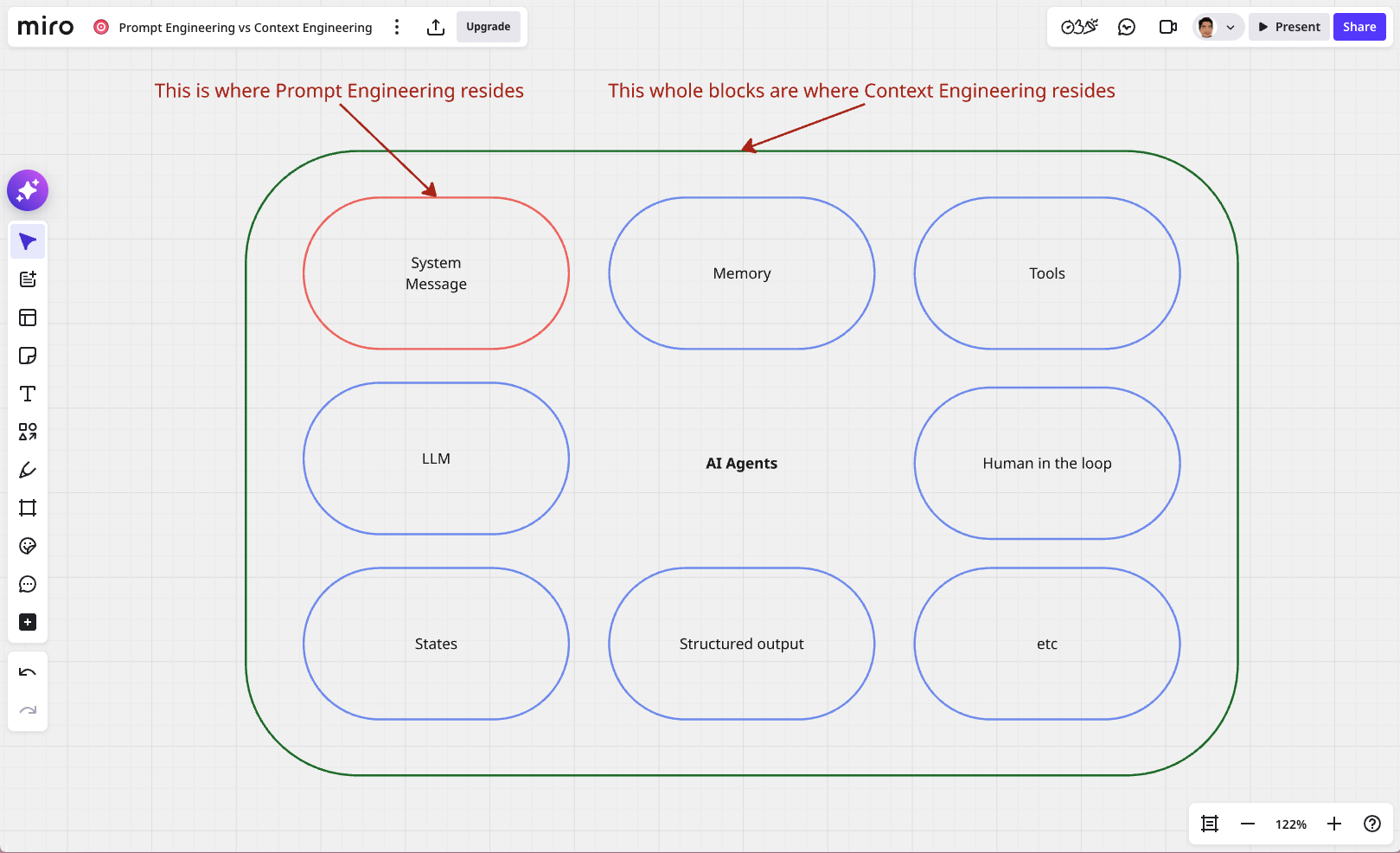
In other words, prompt engineering can be considered a subset of context engineering. To improve AI Agent reliability, prompt crafting is one of the most important measures that needs to be taken into consideration.
Lastly, in building a good AI system, understanding these difference between prompt engineering and context engineering is one of the key to unlock the full potential of LLMs. While prompting ensures that the intructions are clear, precise and actionable, context engineering provides the framework for those instructions to work reliably over time. It can be considered as a cherry on top for Agentic AI workflows.
Mastering both allows us to build AI systems that are not only smart but also consistent, trustworthy, and adaptable to real-world challenges.
Happy prompting and contexting😄.
Written with love by Arif Mustaffa
Back to blog page